
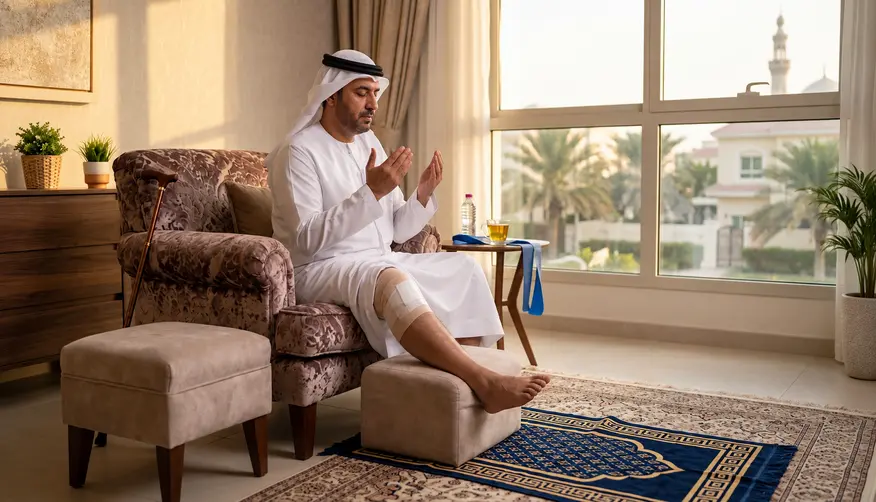
For many patients in Saudi Arabia, returning to daily prayer is an important part of recovery after knee replacement surgery. Patients often ask when they can stand comfortably, perform ruku, kneel, complete sujood, and sit for tashahhud after the operation.
There is no single recovery date that applies to every patient. The ability to return to floor-based prayer depends on the type of knee replacement, wound healing, swelling, pain, knee flexibility, muscle strength, balance, previous range of motion, rehabilitation progress, and the treating surgeon’s assessment.
Saudi patients considering surgery with Dr. Muthana Sartawi can review information about his knee replacement approach in Riyadh, knee replacement recovery, and same-day knee replacement pathway.
Why Prayer Can Be Challenging After Knee Replacement
Muslim prayer can involve substantial knee flexion, particularly during kneeling, sujood, and the seated prayer position. A biomechanical study involving Muslim participants in the Middle East found that kneeling and prayer were among the activities requiring high knee flexion; in the study sample, maximum knee flexion during kneeling was around 140 degrees.
However, the amount of flexion that an individual patient achieves after total knee replacement varies considerably. Pain, scar sensitivity, swelling, muscle weakness, balance, and the range of motion available before surgery can all affect the ability to kneel comfortably.
Research also shows that kneeling can remain difficult for some patients after total knee replacement. A prospective study that specifically evaluated several kneeling positions, including a praying position, found considerable variation in patients’ ability to perform them after surgery.
Can Patients Pray After Knee Replacement?
Yes. Knee replacement surgery does not mean that a patient must stop praying. During the early recovery period, however, the physical position used for prayer may need to be adapted according to the patient’s medical condition and physical ability.
Saudi religious guidance recognizes accommodations for patients who cannot safely perform the normal prayer positions. Guidance on prayer for patients explains that a person who cannot stand because of illness may pray sitting, with further adaptations according to what the individual is physically able to perform.
From a medical perspective, patients should not force kneeling or deep knee bending simply to return to floor prayer before the knee is ready. The surgeon’s and physiotherapist’s instructions should guide the physical progression.
When Can I Perform Sujood After Knee Replacement?
There is no universal number of days or weeks after knee replacement when every patient can safely return to sujood.
Published postoperative instructions vary. The NHS advises patients not to kneel on the replaced knee until their doctor says they can. Oxford University Hospitals advises patients in its rehabilitation material not to try kneeling before approximately six weeks, while the Royal National Orthopaedic Hospital advises that kneeling may need to be avoided for several months.
These differences demonstrate why an internet timeline should not replace individualized medical clearance.
Does Kneeling Damage a Knee Replacement?
Patients are often concerned that placing the knee on the floor will damage the artificial joint.
A review of the medical literature found no biomechanical or clinical evidence that kneeling itself should be universally contraindicated after total knee arthroplasty. However, discomfort and difficulty kneeling remain common, and postoperative timing still needs to account for wound healing and individual recovery.
Some patients may experience tenderness or numbness around the surgical scar. Others may have sufficient knee movement but still feel uncomfortable placing direct pressure on the knee. This does not necessarily indicate that the implant is damaged.
What About Dr. Sartawi’s Knee Replacement Technique?
Dr. Muthana Sartawi developed the Modified Intervastus Approach for total knee replacement. The original peer-reviewed publication describes an approach designed to preserve the extensor mechanism and vastus medialis, with the aim of supporting a more rapid return of active knee extension compared with what is traditionally observed with some other approaches. Read the Modified Intervastus Approach study on PubMed
Dr. Sartawi’s website also describes a same-day knee replacement program and states that, with his closure technique, some capable selected patients may achieve substantial bending and even prayer-related movement very early after surgery. This should not be interpreted as a guarantee that every patient can perform full floor prayer on the day of surgery. Recovery and eligibility depend on the patient’s medical and functional condition.
A Safe Progression Back to Floor Prayer
During the first stage of recovery, patients may need to pray using a chair or another medically appropriate modified position rather than repeatedly lowering themselves to and rising from the floor.
As recovery progresses, physiotherapy focuses on improving knee movement, strength, balance, walking, and functional independence. Dr. Sartawi’s knee replacement recovery guide and before and after knee replacement guide provide additional information about rehabilitation.
Before attempting normal floor prayer, it is useful for the patient and clinical team to assess:
- whether the surgical wound has healed appropriately;
- whether pain and swelling are adequately controlled;
- whether sufficient knee flexion has returned;
- whether the patient can safely lower himself or herself toward the floor;
- whether the patient can rise again without losing balance;
- whether placing pressure on the operated knee is comfortable enough;
- whether the surgeon or physiotherapist has placed any temporary restrictions on kneeling.
When permission is given to begin kneeling, starting on a soft prayer mat, cushion, or padded surface may reduce discomfort. Some rehabilitation guidance specifically recommends beginning on a soft surface before progressing to harder surfaces.
Why Physiotherapy Matters for Returning to Prayer
Successful prayer-related movement is not determined only by the artificial joint. Muscle strength, flexibility, balance, confidence, and rehabilitation also play important roles.
Research examining kneeling after knee replacement has found that patients with greater achievable knee flexion were more likely to kneel successfully. Pain and discomfort are also common reasons why patients avoid kneeling even when the prosthesis itself is not preventing the movement.
Patients should therefore follow the rehabilitation program prescribed by their surgeon and physiotherapist rather than aggressively forcing the knee into deep flexion.
Total vs Partial Knee Replacement and Prayer
Not every patient requires a total knee replacement. Some patients whose arthritis is limited to one compartment may be candidates for a partial knee replacement.
The appropriate procedure depends on examination, imaging, ligament condition, location of arthritis, alignment, and other clinical factors. Patients can review Dr. Sartawi’s information about partial knee replacement and his comparison of partial versus total knee replacement.
The type of procedure alone does not guarantee the ability to kneel or perform sujood. Recovery remains individualized.
When Should Prayer Positions Be Modified Again?
Even after a patient begins returning to floor prayer, forcing the knee through increasing pain is not advisable.
The patient should contact the medical team if there is significant or increasing swelling, rapidly worsening redness around the wound, drainage, fever, new difficulty walking, severe pain, or another unexpected change in the operated knee.
A temporary return to a modified prayer position may be appropriate if normal floor prayer is causing substantial pain or if the medical team recommends reducing pressure or deep flexion while the knee is being evaluated.
Knee Replacement Consultation in Saudi Arabia
Patients in Saudi Arabia who want an individualized assessment can contact Dr. Sartawi’s team regarding current consultation availability in Riyadh. His official website lists Riyadh Hospital among his Saudi Arabia locations and provides +966 50 019 5859 as the Saudi WhatsApp contact. Because schedules can change, patients should confirm the current clinic and appointment details before attending.
Patients preparing for an evaluation can also review the Riyadh knee replacement information and contact the team through the official Dr. Sartawi contact page.
Frequently Asked Questions
Is kneeling harmful to the artificial knee?
Available research does not show that kneeling must be permanently prohibited after total knee replacement. However, the wound and surrounding tissues need time to recover, and kneeling may remain uncomfortable for some patients.
What if I cannot kneel during prayer?
During medical recovery, prayer positions can be adapted according to physical ability. Saudi religious guidance provides accommodations for patients who cannot safely stand, kneel, or prostrate normally.
Will every patient be able to pray normally on the floor again?
No result can be guaranteed. Many patients regain substantial movement, but research shows that kneeling ability varies considerably after knee replacement. Preoperative movement, pain, rehabilitation, strength, scar sensitivity, and individual healing can all influence the outcome.
Should I practice deep knee bending to return to prayer faster?
Only according to the rehabilitation plan provided by the treating team. Aggressively forcing deep flexion can increase pain or swelling and is not a substitute for structured physiotherapy.