
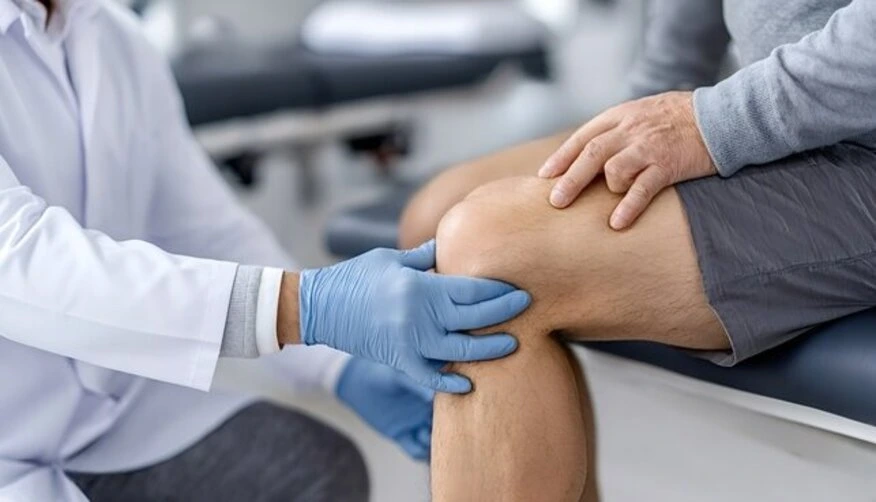
Patients considering knee replacement often want to understand not only whether surgery is appropriate, but also which surgical approach may be used.
Dr. Muthana Sartawi performs knee replacement surgery in Riyadh using the Modified Intervastus Approach, an innovative surgical technique developed to preserve important muscles and tendons around the knee.
This patented technique is not robotic-assisted surgery. The surgeon remains responsible for evaluating the patient, planning the procedure, performing the operation and managing the patient’s recovery.
Patients searching for a knee replacement surgeon in Riyadh should receive an individualized assessment before deciding whether total knee replacement, partial knee replacement or another treatment option is appropriate.
When May Knee Replacement Be Considered?
Knee replacement may be discussed when pain, stiffness or joint damage significantly affects mobility and daily activities despite appropriate non-surgical treatment.
An assessment by an orthopedic surgeon in Riyadh may be appropriate when a patient experiences:
- Persistent knee pain
- Significant stiffness
- Difficulty walking or climbing stairs
- Reduced mobility
- Pain affecting sleep or daily activities
- Advanced arthritis or joint damage
- Limited improvement after medication, physiotherapy or injections
These symptoms do not automatically mean that surgery is necessary. Every patient requires a clinical assessment based on symptoms, examination findings, imaging and general health.
What Is the Modified Intervastus Approach?
The Modified Intervastus Approach is a surgical method used to access the knee joint during total knee replacement.
It was developed by Dr. Muthana Sartawi and has been described in a United States patent and peer-reviewed medical publications.
The approach is designed to preserve key structures involved in straightening and controlling the knee, including parts of the quadriceps mechanism. It is described as a muscle- and tendon-sparing approach.
The technique may be used during primary total knee replacement when the surgeon determines that it is suitable for the patient’s anatomy and medical condition.
What Has Been Published About the Technique?
The Modified Intervastus Approach was described in the Journal of Knee Surgery by Dr. Muthana Sartawi and his co-authors.
A later retrospective study reviewed patients who underwent total knee replacement using the approach. The publication examined areas such as pain, movement and walking during recovery.
Because the research was retrospective, its findings should not be presented as a guarantee of identical outcomes for all patients. Recovery can be affected by:
- The severity of joint damage
- The patient’s age and general health
- Muscle strength before surgery
- Other medical conditions
- The type of knee replacement
- Participation in physiotherapy
- Support available after discharge
- The development of complications
What Is Preserved During the Approach?
The muscles and tendons around the knee play an important role in standing, walking and straightening the leg.
The Modified Intervastus Approach is intended to preserve important structures in the knee’s extensor mechanism rather than routinely dividing them to obtain access to the joint.
Preserving these structures may support early movement and rehabilitation. However, the actual surgical plan depends on the patient’s anatomy and the amount of exposure required to perform the operation safely.
The surgeon may need to adapt the approach when additional access to the joint is medically necessary.
Who May Be Assessed for the Technique?
The patented approach is not automatically suitable for every patient.
A knee replacement specialist in Riyadh should assess:
- The location and extent of arthritis
- Knee alignment
- Joint movement
- Ligament condition
- Previous knee operations
- Bone quality
- General medical health
- Imaging findings
- The type of implant and procedure being considered
Patients should not choose a surgical approach based only on online information. The final recommendation must be based on an individualized medical assessment.
How Are Patients Evaluated in Riyadh?
Patients considering knee surgery in Riyadh may begin with an orthopedic consultation.
The assessment may include:
- A discussion of current symptoms
- Review of previous treatment
- Physical examination
- Assessment of walking and knee movement
- Knee X-rays
- MRI or CT imaging when clinically relevant
- Review of previous operation reports
- Medication and allergy review
- Assessment of existing medical conditions
- Discussion of the patient’s expectations
Patients should provide recent reports and original imaging files when possible. Sending medical records supports an initial review, but it does not confirm suitability for surgery.
Request an assessment or submit medical records
Total Knee Replacement Surgery in Riyadh
Total knee replacement surgery in Riyadh may be considered when arthritis or joint damage affects several areas of the knee.
During total knee replacement, the damaged joint surfaces are prepared and replaced with artificial components designed to recreate the knee’s joint surfaces.
The Modified Intervastus Approach relates to how the surgeon accesses the knee joint. It does not replace the clinical steps required to:
- Prepare the damaged bone
- Balance the knee
- Position the components
- Confirm alignment and stability
- Close the surgical area
- Plan rehabilitation
Learn more about knee replacement surgery
Total or Partial Knee Replacement
The appropriate knee replacement surgery procedure depends on which parts of the joint are damaged.
Total Knee Replacement
Total knee replacement may be considered when damage affects several areas of the knee.
Some patients search for “complete knee replacement surgery,” but the standard medical terms are total knee replacement and total knee arthroplasty.
Partial Knee Replacement
Partial knee replacement may be considered for selected patients when the damage is limited to one compartment of the knee.
Only the damaged part is replaced, while suitable healthy structures are preserved.
The decision between partial and total knee replacement must be based on examination and imaging rather than on patient preference alone.
Preparing for Knee Replacement Surgery
Preparation may begin several weeks before the planned procedure.
Depending on the patient, the pre-operative process may include:
- A complete medical assessment
- Blood and urine tests
- Heart or respiratory assessment when indicated
- Medication and supplement review
- Updated knee imaging
- Anaesthesia consultation
- Specialist clearance for chronic conditions
- Planning transport and home support
- Preparing a safe recovery area
- Arranging physiotherapy
Patients should not stop blood thinners, diabetes medication or other prescribed treatments unless instructed by the treating medical team.
Read the guide to preparing before and after knee replacement surgery
What Happens During Surgical Knee Replacement?
Before the operation, the medical team should explain:
- The recommended procedure
- Why it is being considered
- Available alternatives
- Potential benefits
- Possible risks and complications
- Anaesthesia planning
- Pain-management planning
- Rehabilitation expectations
- Discharge requirements
- Follow-up arrangements
During surgical knee replacement, damaged joint surfaces are prepared and artificial components are positioned to recreate the joint surfaces.
The exact steps depend on whether the operation is total or partial, the patient’s anatomy and the chosen surgical approach.
Recovery and Rehabilitation
Recovery differs between patients and should not be presented as a fixed or guaranteed timeline.
Early rehabilitation may involve:
- Pain-management medication
- Assistance with standing and walking
- Use of crutches or a walking frame
- Exercises supervised by a physiotherapist
- Wound-care instructions
- Gradual improvement in movement and strength
- Follow-up appointments
- Progressive return to daily activities
Full recovery may take several months or longer. Progress depends on the patient’s health, procedure, rehabilitation and individual response.
Selected patients may be assessed for a same-day knee replacement pathway. Same-day discharge is not suitable or guaranteed for every patient.
Riyadh Consultation and Surgery Booking Contacts
Patients in Riyadh have two separate contact points: Riyadh Hospital for consultation and hospital information, and a dedicated Riyadh surgery-booking service for planned procedures. Patients should confirm the current schedule, the treating hospital and the purpose of the appointment before making travel or admission arrangements.
1. Riyadh Hospital
- Patients can contact Riyadh Hospital for consultations and hospital information. The hospital is located
- on King Abdullah Road, Al Mughrizat, Riyadh 12481, Saudi Arabia. To confirm appointment availability and
- the current schedule, patients can visit the official Riyadh Hospital website or contact the Riyad appointment team on WhatsApp at +966 50 019 5859.
2. Al Mana General Hospital (Aziziah)
- Patients can contact Al Mana General Hospital (Aziziah) for consultations and hospital information. The hospital is located in Al Aziziyah, Dammam, Eastern Province, Saudi Arabia. To confirm appointment availability and the current consultation schedule, patients can visit the official Al Mana General Hospital page or contact the Almana patient team on WhatsApp through the care centre at 920 033 440.
Frequently Asked Questions
Is the patented technique suitable for all patients?
No. Suitability depends on the patient’s anatomy, diagnosis, previous surgery, imaging and general health.
Does the patent guarantee better results?
No. A patent protects an invention or method. It does not guarantee superiority or identical outcomes for every patient.
Can the technique be used for partial knee replacement?
The patented approach is primarily described in relation to total knee replacement. The surgeon must determine which approach and procedure are appropriate for each patient.