
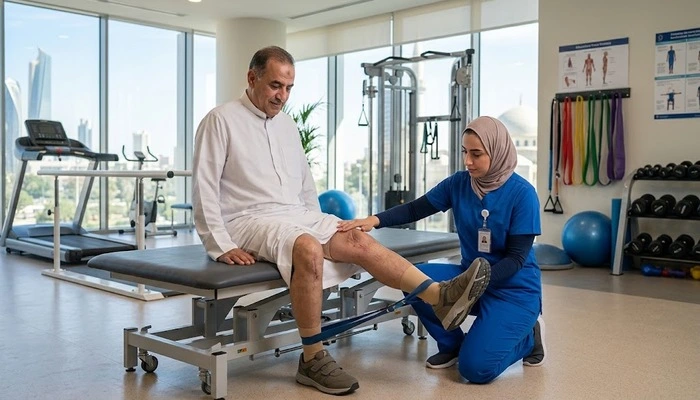
Physiotherapy is one of the most important parts of recovery after knee replacement surgery. The operation addresses the damaged joint, but rehabilitation helps patients regain knee movement, muscle strength, balance, walking ability, and confidence when returning to everyday activities.
For patients recovering from knee replacement in Kuwait, physiotherapy should follow an individualized plan created by the orthopedic surgeon and physiotherapist. Recovery is different for every patient and depends on factors such as overall health, the type of knee replacement, pre-operative mobility, muscle strength, and progress after surgery.
The American Academy of Orthopaedic Surgeons (AAOS) emphasizes that regular exercise, restoration of strength and mobility, and a gradual return to daily activities are important after total knee replacement. Exercises should be performed according to the guidance of the treating surgeon and physical therapist. See the AAOS Total Knee Replacement Exercise Guide.
Patients can also read Dr. Sartawi’s detailed guide to knee replacement recovery and his Joint Replacement Guide for Patients from Kuwait.
Why Is Physiotherapy Important After Knee Replacement?
Knee replacement surgery can relieve pain caused by severe arthritis or joint damage, but patients still need time and rehabilitation to regain function.
After surgery, the muscles around the knee may be weaker, the joint may feel stiff, and walking may initially require assistance. Physiotherapy is designed to gradually improve these areas while helping the patient return safely to normal activities.
A rehabilitation program commonly focuses on improving knee bending and straightening, rebuilding leg strength, improving balance and walking technique, increasing independence with daily activities, and safely progressing toward longer periods of walking and other appropriate exercises.
The AAOS explains that patients should actively participate in their recovery and continue exercises prescribed by their physical therapist. Walking is useful, but it should not automatically replace the specific rehabilitation exercises recommended by the medical team. More information: AAOS Activities After Total Knee Replacement.
More information about long-term rehabilitation is available in Dr. Sartawi’s guide to life after total knee replacement surgery.
When Does Physiotherapy Start After Knee Replacement?
Rehabilitation often begins very early after knee replacement, depending on the patient’s medical condition and the type of procedure performed.
In many cases, patients are encouraged to stand and begin walking with assistance soon after surgery. A physiotherapist may initially teach the patient how to get out of bed safely, use a walker or crutches, perform basic knee movements, and complete simple exercises.
The NHS notes that patients are commonly helped by nurses and physiotherapists to begin walking soon after knee replacement. Before going home, patients may also receive instructions for managing everyday activities and completing a home exercise program. See NHS Knee Replacement Recovery.
Patients preparing for surgery can review Dr. Sartawi’s guide about before and after knee replacement surgery to better understand the different stages of the treatment and recovery process.
The First Stage of Physiotherapy
During the early recovery period, physiotherapy generally concentrates on restoring basic movement and helping the patient become safely mobile.
The physiotherapist may work on gentle knee bending and straightening, activation of the muscles around the knee, safe transfers from a bed or chair, walking with an appropriate mobility aid, and gradually increasing the distance the patient can walk.
Swelling and stiffness can occur after surgery, so the rehabilitation program needs to progress gradually. Patients should avoid comparing their recovery with someone else’s, because the speed of improvement varies considerably.
Patients recovering in Kuwait should continue the rehabilitation program prescribed by their surgical and physiotherapy team rather than following a generic exercise program found online.
Dr. Sartawi’s post-surgery follow-up guide for patients in Kuwait provides additional information about physiotherapy, follow-up appointments, wound monitoring, medication management, and recovery after returning to Kuwait.
Building Knee Strength and Range of Motion
As recovery progresses, physiotherapy usually places greater emphasis on restoring knee range of motion and strengthening the muscles that support the joint.
Exercises may progressively target the quadriceps, hamstrings, calves, hips, balance, and overall lower-limb control. Walking may also be increased gradually according to the patient’s tolerance and the physiotherapist’s assessment.
There is no single exercise routine that is appropriate for every knee replacement patient. The type, intensity, frequency, and progression of exercises should be adjusted according to the patient’s operation and recovery.
Patients looking for examples can consult the AAOS Total Knee Replacement Exercise Guide. AAOS specifically advises patients to check with their orthopedic surgeon or physical therapist before attempting an exercise program.
Walking After Knee Replacement
Walking is an important part of recovery, but patients may initially require a walker, crutches, or another mobility aid.
The goal is not simply to walk as far as possible. Early rehabilitation also focuses on walking safely and progressively improving gait, strength, balance, and confidence.
The decision to stop using a walker, crutches, or cane should be based on the patient’s stability and progress rather than on a fixed number of days after surgery.
As strength and control improve, the physiotherapist can guide the patient toward progressively greater independence.
For more information about returning to everyday activities, patients can review the AAOS Activities After Total Knee Replacement guide.
Physiotherapy After Same-Day Knee Replacement
Some suitable patients may undergo knee replacement through a same-day discharge program. Leaving the hospital on the day of surgery does not mean that rehabilitation is complete.
Physiotherapy and follow-up remain important after discharge. The patient still needs to follow the prescribed walking program, exercises, medication instructions, wound-care recommendations, and follow-up schedule.
Dr. Sartawi describes his approach and postoperative rehabilitation considerations on his Same-Day Knee Replacement Surgery page.
Eligibility for same-day discharge is determined individually by the medical team. Patients should not assume that the same recovery pathway is suitable for everyone.
Physiotherapy at Home or in a Clinic?
Depending on the patient’s condition, physiotherapy after knee replacement may include supervised sessions together with exercises performed at home.
The most important factor is having a structured rehabilitation plan and following it consistently. A physiotherapist can assess movement, strength, walking technique, balance, and functional progress and adjust the program when necessary.
Home exercises are also an important part of recovery because rehabilitation continues between appointments. However, patients should perform the exercises prescribed for their specific condition rather than adding exercises without medical guidance.
For patients who have undergone surgery outside Kuwait and are returning home, coordination between the surgeon and the physiotherapy team is especially important. Dr. Sartawi’s post-surgery follow-up guide for Kuwait patients discusses continuing physiotherapy and medical follow-up after returning to Kuwait.
Returning to Daily Activities
Patients usually become progressively more independent as strength, mobility, and confidence improve.
Returning to work, driving, stairs, exercise, travel, and other activities should be individualized. Recovery after knee replacement may continue for several months, and patients should obtain appropriate medical clearance rather than relying only on a standard timeline.
The NHS notes that full recovery from knee replacement can take several months or longer and varies according to factors such as age and general health. See NHS Knee Replacement Recovery.
For a broader overview of the recovery process, see Dr. Sartawi’s Knee Replacement Recovery guide.
What Activities Are Suitable After Knee Replacement?
As recovery progresses, many patients can return to everyday activities and appropriate low-impact exercise once their surgeon or physiotherapist approves.
AAOS identifies activities such as walking, swimming, cycling, golf, and other lower-impact activities as common options after recovery, while activities that place excessive repetitive stress on the replaced knee may not be recommended. See AAOS Activities After Total Knee Replacement.
The exact activity program should always be personalized to the patient’s health, implant, strength, balance, previous activity level, and rehabilitation progress.
When Should a Patient Seek Medical Advice?
Some discomfort, stiffness, bruising, warmth, and swelling may occur during normal recovery, but patients should monitor their symptoms carefully.
Patients should seek prompt medical assessment for warning signs such as increasing redness, tenderness, swelling, or drainage around the surgical wound; persistent fever or chills; increasing pain at rest or during activity; unusual calf pain or rapidly increasing leg swelling; sudden shortness of breath or chest pain.
AAOS lists increasing wound redness or drainage, persistent fever, increasing calf or leg swelling, and symptoms such as sudden shortness of breath or chest pain among warning signs requiring medical attention. See AAOS Activities After Total Knee Replacement.
Urgent or rapidly worsening symptoms should be evaluated immediately rather than waiting for the next physiotherapy appointment.
Knee Replacement Follow-Up in Kuwait
Patients in Kuwait should maintain regular communication with their orthopedic and rehabilitation teams throughout recovery.
Dr. Muthana Sartawi is listed by New Mowasat Hospital as a Consultant Orthopedic Surgeon within its International Visiting Doctors program, with a focus on same-day surgery and fast recovery for knee replacement. Because visiting schedules may change, patients should confirm current appointment availability directly with the hospital.
Patients can view Dr. Sartawi’s official New Mowasat Hospital profile or use the hospital’s official New Mowasat Hospital contact page to confirm appointments and current availability.
New Mowasat Hospital is located in Salmiya, Kuwait, and its official website lists its main contact number as +965 182 6666.
Frequently Asked Questions About Physiotherapy After Knee Replacement
How long is physiotherapy needed after knee replacement?
There is no single duration suitable for every patient. Physiotherapy may continue for weeks or months depending on knee movement, strength, walking ability, functional goals, overall health, and the patient’s progress.
How often should exercises be performed?
Exercise frequency should be determined by the physiotherapist or orthopedic surgeon. AAOS provides general examples of postoperative exercise programs but specifically recommends following the program prescribed by the patient’s healthcare team.
Is walking enough after knee replacement?
Walking is valuable, but it does not necessarily replace rehabilitation exercises. Strength, range of motion, balance, and functional exercises may also be necessary. AAOS recommends continuing exercises prescribed by the physical therapist during recovery.
When can I walk without a cane or walker?
There is no universal date. The decision should depend on walking stability, muscle control, balance, pain, and the assessment of the treating physiotherapist or surgeon.
Can physiotherapy be continued in Kuwait if surgery was performed abroad?
Yes. Patients returning to Kuwait can continue an individualized rehabilitation program locally, but the physiotherapist should ideally have access to the surgical and discharge information and follow the postoperative recommendations provided by the treating surgical team.
Planning Knee Replacement Recovery in Kuwait
Successful rehabilitation after knee replacement requires cooperation between the patient, orthopedic surgeon, physiotherapist, and wider medical team.
Physiotherapy helps patients progressively restore movement, strength, balance, and independence, but rehabilitation should always be tailored to the individual rather than based on a rigid online schedule.
Patients considering knee replacement or continuing their recovery in Kuwait can review the Joint Replacement Guide for Patients from Kuwait and the Post-Surgery Follow-Up for Patients Returning to Kuwait.
For further information about Dr. Muthana Sartawi, his joint replacement approach, and available treatment locations, visit the official Dr. Sartawi website or confirm current Kuwait appointments through New Mowasat Hospital.