
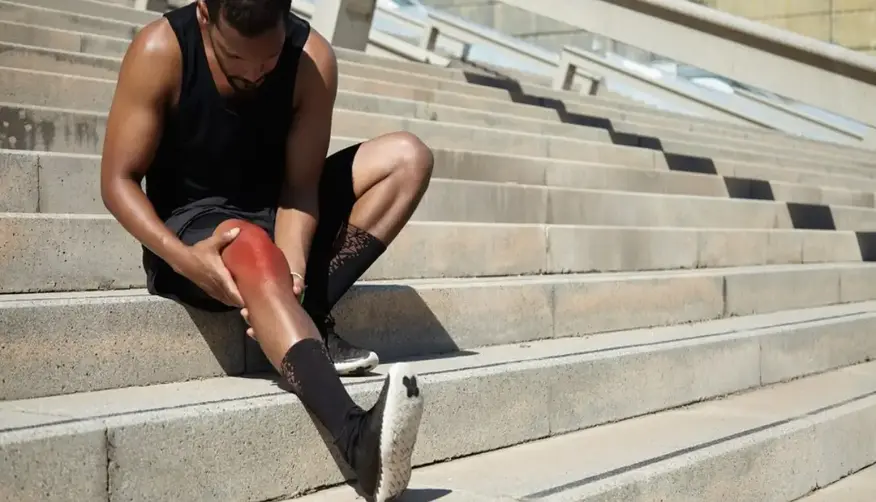
For active adults in Doha and across Qatar, knee pain can raise an important question: is this a sports-related knee injury, or could it be arthritis? The symptoms can overlap, especially when pain, swelling, stiffness, or reduced movement appear after exercise.
A sports injury often follows a specific movement, twist, impact, sudden stop, or increase in training load, while arthritis more commonly develops gradually and may cause recurring pain and stiffness over time. However, symptoms alone cannot always confirm the diagnosis, and some people may have both an injury and underlying arthritis. NHS knee pain guidance.
Patients in Qatar can be evaluated by Dr. Muthana Sartawi at The View Hospital in Doha, where he is listed as a visiting Consultant in Orthopedic Surgery. Patients should confirm his current clinic schedule before attending. Knee Replacement Guide for Patients in Qatar.
Why Knee Pain Is Common in Active Adults
Running, football, padel, gym training, basketball, cycling, and other physical activities place repeated loads on the knee. Most active adults can exercise safely, but sudden twisting, pivoting, jumping, direct impact, or repetitive overload can sometimes cause ligament, meniscus, tendon, or cartilage injuries.
At the same time, osteoarthritis can also affect active adults, particularly those with previous knee injuries, long-term joint stress, or progressive cartilage changes.
Dr. Sartawi’s website provides additional information about common knee injuries.
Signs That Suggest a Sports Knee Injury
A sports injury is more likely when symptoms begin after a clear event such as:
- twisting the knee while the foot is planted;
- landing awkwardly after a jump;
- changing direction suddenly;
- receiving a direct impact;
- increasing training intensity rapidly.
An ACL injury, for example, may be associated with a popping sensation, rapid swelling, reduced range of motion, difficulty bearing weight, and a feeling that the knee is unstable or gives way.
A meniscus tear may cause pain, stiffness, swelling, catching or locking, giving way, or difficulty moving the knee through its full range of motion. Sports-related meniscus tears commonly occur during pivoting or cutting movements. AAOS: Meniscus Tears.
Signs That May Suggest Knee Arthritis
Arthritis usually has a different pattern.
Knee osteoarthritis commonly causes pain and stiffness that develop progressively rather than after one obvious injury. Symptoms can include tenderness, reduced movement, stiffness after inactivity, weakness, and grinding or crackling sensations. Pain may become more noticeable when walking, climbing stairs, or performing weight-bearing activity. NHS osteoarthritis symptoms.
Dr. Sartawi’s guide on what arthritis knee pain may feel like also discusses progressive pain, stiffness, swelling, limited movement, and difficulty with activities.
Injury vs. Arthritis: A Simple Comparison
| Feature | Sports Knee Injury | Knee Arthritis |
| Onset | Often sudden | Usually gradual |
| Trigger | Twist, impact, jump, sport | May develop without one clear injury |
| Swelling | Can develop quickly | Often intermittent or progressive |
| Instability | Common with ligament injury | May occur in advanced disease |
| Locking/catching | Possible with meniscus injury | Can occur but is less specific |
| Stiffness | Often after injury/swelling | Common after rest or inactivity |
| Pain pattern | Related to injured structure/activity | Often progressive with weight-bearing |
| Age | Can occur at any age | More common with increasing age, but not exclusive to older adults |
This comparison is only a guide. A meniscus tear, previous ACL injury, or cartilage damage can coexist with osteoarthritis, so symptoms should not be used for self-diagnosis.
Can a Previous Sports Injury Lead to Arthritis Later?
Yes. A previous knee injury can increase the likelihood of later degenerative changes in the joint. This is one reason why persistent symptoms after an ACL tear, meniscus injury, or other significant knee trauma should be properly assessed rather than ignored.
For active patients, treatment is not only about controlling current pain. The orthopedic team also considers stability, cartilage condition, strength, alignment, activity goals, and the long-term health of the joint.
Does Pain During Exercise Always Mean an Injury?
No.
Knee pain during exercise may come from overuse, tendon irritation, muscle imbalance, arthritis, bursitis, meniscus problems, ligament injury, or several other causes. The NHS specifically advises against self-diagnosing knee pain because different conditions can produce similar symptoms. NHS knee pain guidance.
Pain at the front of the knee during running, for example, can have multiple causes and does not automatically mean that the ACL or meniscus is damaged. NHS running injuries guidance.
When Should an Active Adult Stop Training?
Continuing to train through significant pain is not advisable.
An orthopedic assessment should be considered when knee symptoms:
- persist despite reducing activity;
- repeatedly return during sport;
- cause swelling after exercise;
- make the knee lock or give way;
- reduce confidence during running or changing direction;
- affect sleep or daily activities;
- prevent normal walking or stair climbing.
Urgent assessment may be needed when the knee is severely painful, cannot bear weight, becomes markedly swollen or deformed, locks completely, or is hot and red with fever or systemic illness. NHS knee pain guidance.
How Is the Difference Diagnosed?
The most reliable way to distinguish between a sports injury and arthritis is through a structured orthopedic assessment.
Medical History
The doctor may ask:
- Did the symptoms begin suddenly or gradually?
- Was there a specific injury?
- Did you hear or feel a pop?
- Did swelling develop immediately?
- Does the knee give way?
- Is there stiffness after rest?
- Which sports or activities trigger the symptoms?
- Have you previously injured or operated on the knee?
Physical Examination
The orthopedic surgeon assesses swelling, tenderness, alignment, stability, strength, range of motion, and movements that reproduce symptoms.
X-rays
X-rays are particularly useful when arthritis or bone abnormalities are suspected. They may show degenerative changes, alignment problems, or reduced joint space.
MRI
MRI is often more useful when a soft-tissue injury such as an ACL tear, meniscus tear, cartilage injury, or another internal knee problem is suspected.
AAOS notes that X-rays do not show a meniscus tear directly, while MRI can help evaluate soft-tissue structures when clinically appropriate. AAOS: Meniscus Tears.
Orthopedic Assessment for Active Adults in Qatar
Patients in Qatar can be assessed at The View Hospital in Doha. A knee consultation may include discussion of the injury or pain pattern, previous treatment, sport and activity goals, a physical examination, and review of X-rays or other imaging when clinically needed. Knee Replacement Guide for Patients in Qatar.
Dr. Sartawi is a visiting orthopedic consultant, so appointments are periodic rather than fixed throughout the year.
For Qatar appointments, patients can contact Dr. Sartawi’s team / The View Hospital via WhatsApp at +974 3304 3950 to confirm current availability and appointment details.
Frequently Asked Questions
Can arthritis pain start after exercise?
Yes. Arthritis symptoms may become more noticeable after increased physical activity, even when there was no new injury. Exercise-related pain alone does not confirm whether the cause is arthritis or an acute injury.
Is a popping sound always an ACL tear?
No. A pop during an injury can occur with ACL or other knee injuries, but diagnosis requires examination and often imaging when clinically indicated.
Can I have both arthritis and a sports injury?
Yes. An active adult may have underlying arthritis and then sustain a meniscus, ligament, or other knee injury. Treatment should consider both problems.
Should I get an MRI immediately?
Not always. The type of imaging should be based on the clinical assessment. X-rays may be more useful when arthritis is suspected, while MRI may be considered for ligament, meniscus, cartilage, or other soft-tissue injuries.
When should I see an orthopedic surgeon?
Consider an orthopedic assessment if symptoms persist, repeatedly return, interfere with sport or normal activity, or are associated with instability, locking, significant swelling, or reduced movement.