
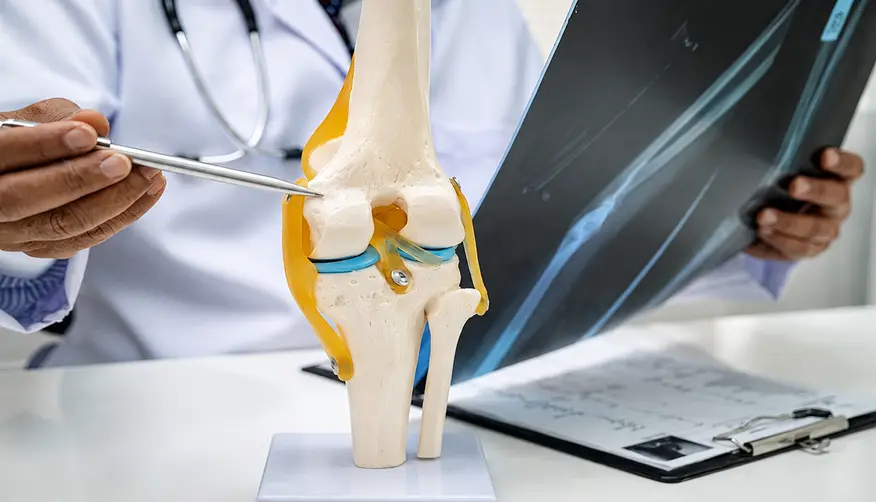
Patients in Doha and across Qatar who are living with advanced knee arthritis often want to know when knee replacement may be appropriate, what the operation involves, how recovery is managed and where they can be assessed locally. Dr. Muthana Sartawi is listed by The View Hospital in Doha as a Consultant in Orthopedic Surgery, with areas of expertise that include total knee replacement, same-day discharge joint replacement, minimally invasive joint replacement techniques and complex knee revisions. Because visiting-doctor availability is periodic, patients should confirm the current clinic schedule before attending.
This guide provides general educational information and does not replace an individualized medical assessment. The decision to proceed with surgery, the type of knee replacement and the recovery plan must be based on the patient’s symptoms, examination, imaging, general health and personal goals.
When May Knee Replacement Be Considered?
Knee replacement is usually considered when advanced arthritis or another serious joint problem causes persistent pain, stiffness, swelling or deformity that limits walking, stairs, sleep, work or normal daily activities, and when appropriate non-surgical treatments have not provided enough relief. The American Academy of Orthopaedic Surgeons overview of total knee replacement explains that the recommendation is based on pain and disability rather than age alone. Patients can also review Dr. Sartawi’s guide to the period before and after knee replacement surgery for a broader overview of preparation and recovery.
Not every patient with knee pain needs a replacement. Depending on the diagnosis, treatment may still include medicines, activity modification, physiotherapy, injections or another surgical option. An orthopedic assessment is needed to determine whether replacement is appropriate.
Consultation and Assessment in Qatar
Patients in Qatar can be evaluated at The View Hospital’s Orthopedic Surgery department in Doha. A knee-replacement assessment typically includes a detailed discussion of symptoms and previous treatment, a physical examination of alignment, stability, strength and range of motion, and a review of X-rays. MRI or CT imaging may be considered when it is clinically useful. Patients should bring previous reports, imaging, medication lists and records of any earlier knee surgery.
The View Hospital describes Dr. Sartawi as a visiting orthopedic consultant, so appointment dates are not fixed throughout the year. The hospital’s current Dr. Muthana Sartawi profile advises patients to confirm availability. For Dr. Sartawi’s Qatar team, the WhatsApp number provided for patient contact is +974 3304 3950. The View Hospital’s official appointment telephone listed on its website is +974 4144 2999.
What Does Knee Replacement Actually Do?
Total knee replacement is sometimes described as replacing the whole knee, but the procedure is more accurately understood as resurfacing the damaged joint surfaces. According to AAOS guidance on total knee replacement, damaged cartilage and a small amount of underlying bone are prepared, metal components are positioned on the ends of the femur and tibia, and a medical-grade plastic spacer is placed between them to create a smooth moving surface. The exact implant and surgical plan are selected for the individual patient.
Total Knee Replacement or Partial Knee Replacement?
A total knee replacement may be recommended when arthritis or damage involves more than one part of the knee or when the overall pattern of disease makes a partial procedure unsuitable. If the damage is limited to one compartment and the rest of the knee meets the required criteria, a partial knee replacement may be an option. Dr. Sartawi’s partial knee replacement guide explains the concept of replacing only the affected compartment while preserving more of the patient’s natural knee structures.
The choice between total and partial replacement cannot be made from symptoms alone. It requires an examination and appropriate imaging, with consideration of ligament function, deformity, the location of arthritis, previous operations and the patient’s activity goals.
Dr. Sartawi’s Modified Intervastus Approach
Dr. Sartawi developed the Modified Intervastus Approach for total knee arthroplasty. The original peer-reviewed description, indexed on PubMed, reports that the approach preserves the extensor mechanism and the vastus medialis and may allow a more rapid return of active knee extension than is traditionally observed with some conventional approaches. The technique is also described on Dr. Sartawi’s official website and by The View Hospital as part of his knee-replacement practice.
A specific surgical approach is not automatically suitable for every knee. The surgeon must decide what exposure and technique are safest for the individual anatomy, deformity, previous surgery and complexity of the case.
Joint Replacement Program with Same-Day Patient Discharge
The View Hospital lists same-day discharge joint replacement among Dr. Sartawi’s areas of expertise. Dr. Sartawi’s same-day knee replacement information also describes a structured pathway designed to support early mobility and discharge. Same-day discharge should not be treated as a guarantee. It is appropriate only when the patient meets the surgical team’s clinical and functional discharge criteria, has acceptable pain control, can mobilize safely and has an appropriate recovery plan.
AAOS notes in its post-knee-replacement activity guidance that outpatient patients may go home on the day of surgery, but discharge depends on safe mobility, pain control, the ability to manage basic activities and understanding of home instructions.
Preparing for Knee Replacement
Preparation is individualized, but it commonly includes a medical review, medication assessment, appropriate blood tests or other investigations, and management of chronic conditions before surgery. Patients should tell the surgical team about prescription medicines, over-the-counter drugs, vitamins and supplements because some may need to be changed before the operation. The AAOS preparation and recovery resource emphasizes planning ahead and following the treating team’s instructions.
- Bring current X-rays and any MRI or CT scans that have already been performed.
- Provide reports from previous knee operations, if any.
- Bring an updated medication and allergy list.
- Discuss diabetes, heart disease, kidney disease, blood-clot history and other chronic conditions.
- Arrange home support, transport and mobility aids if the team expects they will be needed after surgery.
- Follow the hospital’s fasting, medication and infection-prevention instructions exactly.
What Happens on the Day of Surgery?
The anesthesia and orthopedic teams assess the patient before the procedure. Knee replacement can be performed using general, spinal or regional anesthesia depending on the clinical plan. During total knee replacement, the damaged surfaces are prepared and resurfaced with implant components, alignment and stability are checked, and the incision is closed. After surgery, the patient is monitored in recovery and begins the early mobilization plan when medically appropriate.
Patients who are candidates for same-day discharge must still meet the team’s safety criteria before leaving the hospital. Patients who need additional monitoring, pain control, medical treatment or rehabilitation should remain under appropriate hospital care.
Early Recovery and Physiotherapy
Early recovery focuses on safe walking, pain control, swelling management, wound care, prevention of complications and restoration of knee movement and strength. Physiotherapy should follow the program prescribed by the surgeon and physiotherapist rather than a generic online exercise schedule. Dr. Sartawi’s total knee replacement recovery guide provides additional recovery context, while his guide to reducing swelling after knee surgery discusses common postoperative swelling and recovery measures.
- Take prescribed medicines exactly as directed.
- Use a walker, crutches or cane for as long as the treating team recommends.
- Perform the prescribed range-of-motion and strengthening exercises.
- Keep the wound clean and dry according to the dressing instructions.
- Attend planned physiotherapy and follow-up appointments.
- Do not add new medicines, supplements or exercises without discussing them with the treating team.
Wound, Swelling and Blood-Clot Safety
Some pain, warmth, bruising and swelling can occur during normal healing. However, patients should promptly contact their medical team for increasing wound redness or swelling, drainage, worsening pain, persistent fever or chills. AAOS recovery guidance also lists increasing calf pain, tenderness or redness and new or increasing swelling of the calf, ankle or foot as possible warning signs of a blood clot.
Sudden shortness of breath or sudden chest pain can be signs of a pulmonary embolism and require urgent emergency assessment. Severe or rapidly worsening symptoms should be assessed through local emergency services rather than waiting for an online reply.
Follow-Up in Qatar
Because patients in Qatar can be assessed at The View Hospital in Doha, follow-up can be arranged locally when Dr. Sartawi is available. The exact review schedule depends on the operation and the patient’s progress. A follow-up appointment may include review of pain, wound healing, swelling, walking, knee range of motion, medication use, physiotherapy progress and postoperative imaging when clinically indicated.
According to the practice’s postoperative follow-up process, a dedicated WhatsApp group can be created for a patient to support communication with Dr. Sartawi and his multidisciplinary medical team, including orthopedic, physiotherapy and internal-medicine support. This is useful for non-emergency recovery questions, but it does not replace urgent in-person assessment when warning signs develop.
Returning to Daily Activities
The return to driving, work, exercise and other activities is individualized. The patient should wait for specific clearance rather than following a fixed date found online. AAOS advises that driving generally requires adequate strength and reflexes and that the patient should no longer be taking opioid pain medicine. Low-impact activities are usually preferred over high-impact sports after total knee replacement. Dr. Sartawi’s Life After Total Knee Replacement Surgery offers further information about long-term activity after recovery.
How to Book a Knee Replacement Consultation in Qatar
For Dr. Sartawi’s Qatar consultations, patients can contact the team via WhatsApp at +974 3304 3950 to request or arrange an appointment. They can also contact The View Hospital directly on its official appointment line, +974 4144 2999, to confirm the current visiting schedule and clinic availability. The hospital is located in Legtaifiya, Doha, Qatar. Patients should confirm the date before attending because visiting-physician schedules are periodic and may change.