
Partial vs Full Knee Replacement: Which Option is better?
Millions of people struggle with advanced knee arthritis every year. And when conservative treatments stop working, the big question becomes: partial vs full knee replacement, which one is right for you?
Understanding the difference between partial vs full knee replacement isn’t just about surgery. It’s about mobility, recovery time, long-term results, and getting your life back.
Let’s break it down clearly, so you can make a confident, informed decision.!
Understanding the Basics: Partial vs Full Knee Replacement Explained
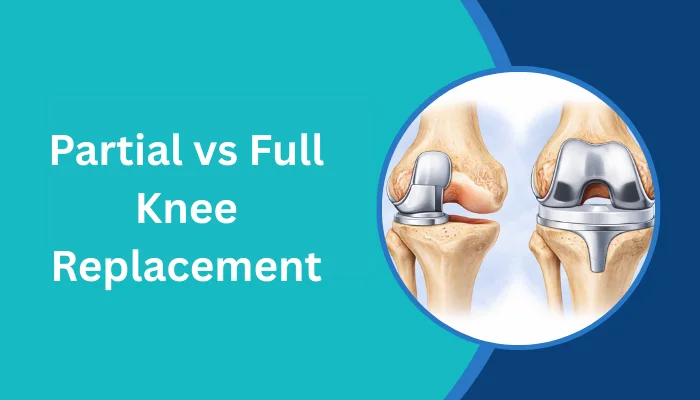
When discussing partial vs full knee replacement, the main difference lies in how much of the knee joint is replaced.
What Is a Partial Knee Replacement?
A partial knee replacement (also called unicompartmental knee replacement) involves replacing only the damaged portion of the knee joint. The knee has three compartments — medial, lateral, and patellofemoral. If arthritis is limited to just one compartment, a partial replacement may be enough.
Key features of partial knee replacement:
- Smaller incision
- Less bone removal
- Preservation of healthy cartilage and ligaments
- Often faster recovery
- More “natural” knee feel post-surgery
What Is a Full Knee Replacement?
A full knee replacement (total knee arthroplasty) replaces all three compartments of the knee. It is recommended when arthritis affects the entire joint or when deformity and instability are present.
Key features of full knee replacement:
- Entire joint surface is replaced
- Suitable for widespread arthritis
- Highly durable implants
- Excellent long-term pain relief
When choosing between partial vs full knee replacement, the extent of joint damage is the primary deciding factor.
Who Is a Candidate? Partial vs Full Knee Replacement Criteria
Choosing between partial vs full knee replacement starts with a detailed evaluation.
You May Be a Candidate for Partial Knee Replacement If:
- Arthritis is limited to one compartment
- Knee ligaments (especially the ACL) are intact
- Minimal knee deformity
- Good range of motion
- Stable knee joint
You May Need Full Knee Replacement If:
- Arthritis affects multiple compartments
- Significant joint deformity (bowed or knock-kneed)
- Severe stiffness
- Ligament damage
- Inflammatory arthritis like rheumatoid arthritis
Studies show that about 10–20% of patients with knee arthritis may qualify for partial replacement, while the majority require full replacement.
That’s why understanding partial vs full knee replacement through proper imaging and clinical assessment is essential.
Recovery Time: Partial vs Full Knee Replacement
Recovery is often a major concern when comparing partial vs full knee replacement.
Recovery After Partial Knee Replacement | Recovery After Full Knee Replacement |
|
|
In general, partial replacement offers quicker initial recovery. However, both procedures provide significant pain relief when appropriately selected.
Longevity and Durability: Partial vs Full Knee Replacement Outcomes
Durability is another major factor in the partial vs full knee replacement conversation.
- Modern full knee replacements can last 15–20 years or longer.
- Partial knee replacements also show excellent outcomes but may have slightly higher revision rates over time if arthritis progresses to other compartments.
However, advances in implant technology and surgical precision have significantly improved the long-term success of both procedures.
According to orthopedic data, total knee replacements have a success rate of over 90% at 15 years. When appropriately selected, partial replacements also demonstrate strong long-term satisfaction rates.
The key takeaway in partial vs full knee replacement decisions: proper diagnosis and surgical expertise matter more than the label of the procedure..
Pros and Cons: Partial vs Full Knee Replacement at a Glance
Here’s a quick comparison to simplify the partial vs full knee replacement decision:
Pros | Cons | |
Partial Knee Replacement |
|
|
Full Knee Replacement |
|
|
Understanding these differences helps clarify the real-world implications of partial vs full knee replacement.
Making the Right Choice: It’s Not About “Better,” It’s About “Right”
The debate around partial vs full knee replacement isn’t about which procedure is superior — it’s about which procedure is correct for your specific condition.
The ideal surgical plan depends on:
- X-ray findings.
- MRI results.
- Physical exam.
- Age and activity level.
- Lifestyle expectations.
Why Trust Dr. Muthana Saratawi for Partial and Full Knee Replacement?
Dr. Muthana Saratawi is known for advanced joint replacement techniques, including minimally invasive approaches and modern knee replacement technology designed to reduce pain and accelerate recovery.
He follows rapid recovery protocols that help many patients stand and walk with assistance within hours after surgery.
His approach focuses on:
- Careful patient selection.
- Detailed surgical planning.
- Modern joint replacement techniques.
- Structured post-operative rehabilitation.
With Dr. Saratawi, choosing between partial vs full knee replacement is a carefully planned strategy to restore strength, stability, and long-term mobility with confidence.
Ready to Take the First Step?
Book your consultation with Dr. Muthana Saratawi today — and take the first step toward pain-free movement.
FAQs:
What type of knee replacement is best?
The best option depends on your condition. When comparing partial vs full knee replacement, partial works best for limited arthritis, while full replacement is better for widespread joint damage.
Who is not a good candidate for partial knee replacement?
Patients with arthritis in multiple compartments, significant deformity, ligament instability, or inflammatory arthritis are usually better suited for full knee replacement.
How long is a hospital stay for a partial knee replacement?
Most patients go home the same day or within 24 hours. Hospital stays are typically shorter compared to full knee replacement.