
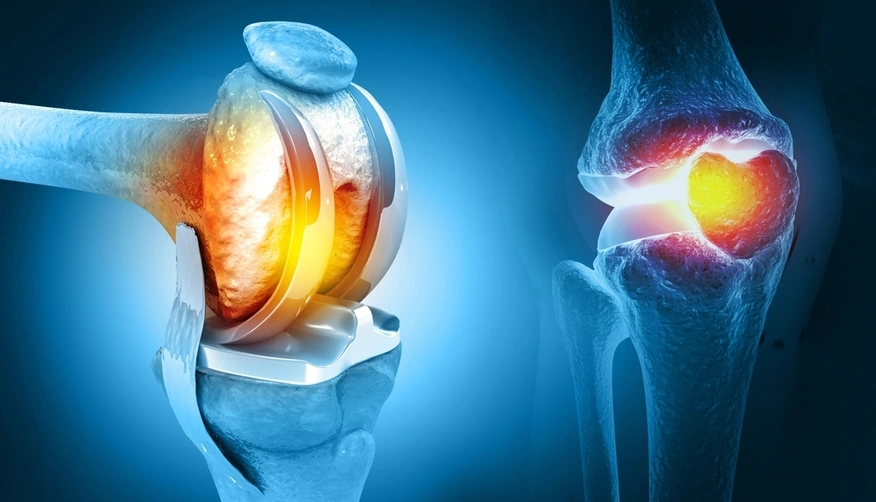
Patients researching knee replacement in Dubai often want to know whether the surgical approach can influence pain, mobility, rehabilitation and the length of hospital stay. The purpose of knee replacement is broadly similar across techniques: the surgeon prepares and resurfaces damaged joint areas, positions artificial components and restores a stable, functional joint. One important difference is how the surgeon reaches the knee.
Dr. Muthana Sartawi developed the Modified Intervastus Approach to the Knee, a patented muscle- and tendon-sparing method used in total knee arthroplasty. The official Dr. Sartawi website presents the technique as part of a rapid-recovery pathway in Dubai. This guide compares that approach with a commonly used traditional medial parapatellar approach while explaining what the available information does—and does not—mean for an individual patient.
What Knee Replacement Actually Replaces
Knee replacement, also called knee arthroplasty, is generally considered when arthritis or joint damage causes persistent pain, stiffness, deformity or loss of function despite suitable non-surgical care. The official page about knee replacement surgery in Dubai describes the operation as resurfacing and restoring an arthritis-damaged knee with metal and medical-grade plastic components.
For patient-facing communication, the clearest wording is “Resurfacing for damaged parts.” The procedure does not mean that the entire knee is simply removed. The surgeon prepares the damaged cartilage and bone surfaces, then caps or resurfaces them with components selected for the patient’s anatomy and condition.
- Total knee replacement may be considered when damage affects several areas of the joint.
- Partial knee replacement may be considered for selected patients when arthritis is limited to one knee compartment.
- Non-surgical treatment may remain appropriate when symptoms and imaging do not justify replacement surgery.
What Is Meant by a Traditional Knee Replacement Approach?
“Traditional knee replacement” can refer to more than one surgical method. In this comparison, it refers mainly to the commonly used medial parapatellar approach. That approach provides broad access to the joint through an incision at the front of the knee and an opening that extends through the medial side of the extensor mechanism, including part of the quadriceps tendon.
The traditional approach remains a widely used and clinically established method. It can provide excellent exposure for implant positioning and may be appropriate in straightforward or complex cases. However, because structures involved in straightening the knee are opened and repaired, early rehabilitation can be influenced by tissue healing, swelling, pain, muscle inhibition and the patient’s pre-operative condition.
It is therefore inaccurate to describe every traditional operation as inferior or to promise that one approach will always produce a better outcome. The surgeon must choose the safest access based on anatomy, deformity, previous surgery, bone quality, ligament condition and the amount of exposure required.
What Is Dr. Sartawi’s Patented Technique?
Dr. Sartawi’s method is identified in the United States patent US10149774B1 as a modified intervastus approach for total knee arthroplasty. The first peer-reviewed description was published as “Modified Intervastus Approach to the Knee” in The Journal of Knee Surgery.
The approach is designed to preserve the extensor mechanism and the vastus medialis while still giving the surgeon access to perform total knee replacement. The official same-day knee replacement surgery page describes it as a muscle- and tendon-sparing technique used within a broader programme that includes patient assessment, anaesthesia, pain management, early mobilisation and physiotherapy.
A later retrospective analysis of the Modified Intervastus Approach evaluated early recovery outcomes. A separate published series described outpatient total knee arthroplasty in the Middle East. These publications provide clinical information, but they do not guarantee identical results for every patient.
Side-by-Side Comparison
| Point | Common Traditional Approach | Dr. Sartawi’s Modified Intervastus Approach |
| Main difference | The joint is commonly accessed through a medial parapatellar opening involving the extensor mechanism. | The joint is accessed through a modified interval intended to preserve the quadriceps mechanism and vastus medialis. |
| Muscles and tendons | Some tissues involved in knee extension are opened and repaired to obtain exposure. | Designed to avoid routinely cutting key muscles and tendons surrounding the knee. |
| Joint resurfacing | Damaged cartilage and bone surfaces are prepared and resurfaced with artificial components. | The same essential resurfacing and implant-positioning steps are completed; the access route is different. |
| Early movement | May be influenced by pain, swelling, tissue healing, muscle inhibition and patient factors. | Muscle- and tendon preservation may support earlier active extension and mobilisation in suitable patients. |
| Hospital pathway | May involve inpatient or outpatient care depending on the patient, facility and protocol. | Used by Dr. Sartawi within a rapid-recovery and selected same-day discharge pathway in Dubai. |
| Suitability | Can be adapted for a broad range of anatomy and complex exposure needs. | Not automatically suitable for every patient; the surgeon may adapt or extend the approach when medically required. |
| Evidence and expectations | A long-established approach with extensive clinical use. | Described in a patent and peer-reviewed publications; outcomes still vary between patients. |
Does the Patented Technique Change the Implant Procedure?
The patent mainly concerns the surgical approach—the route used to reach the joint. It does not remove the need for the standard clinical steps required in knee arthroplasty. The surgeon must still:
- Confirm the diagnosis and determine whether replacement is appropriate.
- Assess alignment, ligaments, bone quality and the location of arthritis.
- Prepare and resurface the damaged joint surfaces.
- Select, position and secure the implant components.
- Balance the knee and confirm alignment, stability and range of movement.
- Close the surgical area and establish a rehabilitation plan.
The official site also discusses customised and 3D-assisted planning. These technologies relate to sizing and positioning, whereas the Modified Intervastus Approach relates primarily to soft-tissue access. They are different parts of the surgical plan.
What Does Same-Day Knee Replacement Mean in Dubai?
Same-day knee replacement means that a selected patient may undergo surgery, complete early recovery checks and leave the hospital on the day of the procedure. Dr. Sartawi’s official Dubai information presents the patented approach as part of a same-day knee replacement pathway rather than as an isolated technique.
Discharge on the same day is not suitable or guaranteed for everyone. Before leaving hospital, a patient generally needs acceptable pain control, medical stability, safe mobility with the recommended support, clear medication and wound-care instructions, a suitable home environment and an organised follow-up plan. Patients with uncontrolled medical conditions, mobility concerns or unexpected postoperative findings may require a longer stay.
Published information on same-day total knee replacement recovery should be treated as general guidance. Recovery varies according to age, health, muscle strength, joint damage, procedure type, physiotherapy participation and individual healing.
Total or Partial Knee Replacement
The patented Modified Intervastus Approach is primarily described in relation to total knee replacement. A patient with damage limited to a single compartment may instead be evaluated for partial knee replacement. Partial replacement preserves appropriate healthy compartments and ligaments, but it is suitable only when the disease pattern, alignment and ligament condition meet the required criteria.
The choice between total and partial replacement should be based on symptoms, examination and imaging—not simply on a preference for a smaller operation. A partial procedure may involve faster early recovery for selected patients, while total replacement may be more appropriate when several compartments are affected.
Who May Be Assessed for Dr. Sartawi’s Technique?
A consultation with a knee replacement surgeon in Dubai is needed to determine whether the technique and a rapid-recovery pathway are appropriate. The assessment may consider:
- The location and severity of arthritis or joint damage.
- Knee alignment, deformity and range of movement.
- The condition of the ligaments and extensor mechanism.
- Previous knee operations and existing scars.
- Bone quality and the proposed implant.
- Age, BMI, general health and relevant chronic conditions.
- Current medications, allergies and anaesthesia considerations.
- Home support, mobility needs and ability to participate in rehabilitation.
Patients should provide recent X-rays, relevant MRI or CT images, previous operation reports, medication lists and information about chronic conditions. Sending records can support an initial review but cannot confirm suitability without a clinical assessment.
Recovery and Post-Operative Follow-Up
Early rehabilitation may include standing and walking with assistance, exercises supervised by a physiotherapist, pain-management medication, wound-care instructions and gradual improvement in movement and strength. The official guidance on life after total knee replacement emphasises realistic goals and continued physiotherapy.
A dedicated WhatsApp group is created for each patient to provide continuous post-operative follow-up with Dr. Sartawi and his multidisciplinary medical team. The team includes an orthopedic surgeon, a physiotherapist and an internal medicine physician. The group allows patients to receive prompt responses to questions or concerns throughout recovery.
Electronic follow-up does not replace emergency care. Severe or rapidly worsening pain, breathing difficulty, chest pain, fainting, uncontrolled bleeding, marked wound drainage, high fever or other urgent symptoms require immediate medical assessment.
Benefits, Limits and Realistic Expectations
The potential early-recovery advantage of a muscle- and tendon-sparing approach is clinically relevant, but a patent is not a guarantee of superiority. A patent protects an invention or method. It does not establish that every patient will recover faster, experience less pain or obtain the same long-term result.
Outcome is influenced by the severity of arthritis, pre-operative muscle strength, age, weight, diabetes or cardiovascular disease, implant selection, alignment, rehabilitation, home support and complications. The surgeon may also need to modify the planned approach when additional exposure is necessary to perform the procedure safely.
The most useful comparison is therefore not “new versus old” in absolute terms. It is whether a specific approach gives the surgeon safe access, protects appropriate tissues, permits accurate implantation and matches the individual patient’s medical and anatomical needs.
Questions Dubai Patients Can Ask During Consultation
- Which parts of my knee are damaged?
- Do I need total knee replacement, partial knee replacement or continued non-surgical treatment?
- Am I suitable for the Modified Intervastus Approach?
- Which muscles, tendons or other tissues will be opened during my operation?
- Could my anatomy or previous surgery require a different or extended approach?
- What implant and planning technology are recommended for my case?
- Am I medically suitable for same-day discharge?
- When will I stand, walk and begin physiotherapy?
- What support and equipment will I need at home?
- How will the WhatsApp follow-up group and clinic appointments be organised?
- Which symptoms require urgent medical attention?
Conclusion
The key difference between Dr. Sartawi’s patented technique and a commonly used traditional knee replacement approach is the route used to access the joint. A traditional medial parapatellar approach opens part of the extensor mechanism to provide exposure. The Modified Intervastus Approach is designed to preserve important muscles and tendons while allowing the surgeon to complete the essential steps of total knee replacement.
For suitable Dubai patients, the technique may support early mobilisation within a structured rapid-recovery or same-day pathway. It is not automatically appropriate for every knee, and no surgical technique guarantees a particular result. The final recommendation should follow an individual examination, imaging review and medical assessment.
Patients can learn more through the official Dr. Sartawi website or contact the official UAE team through the details published on the Dubai knee surgeon page.